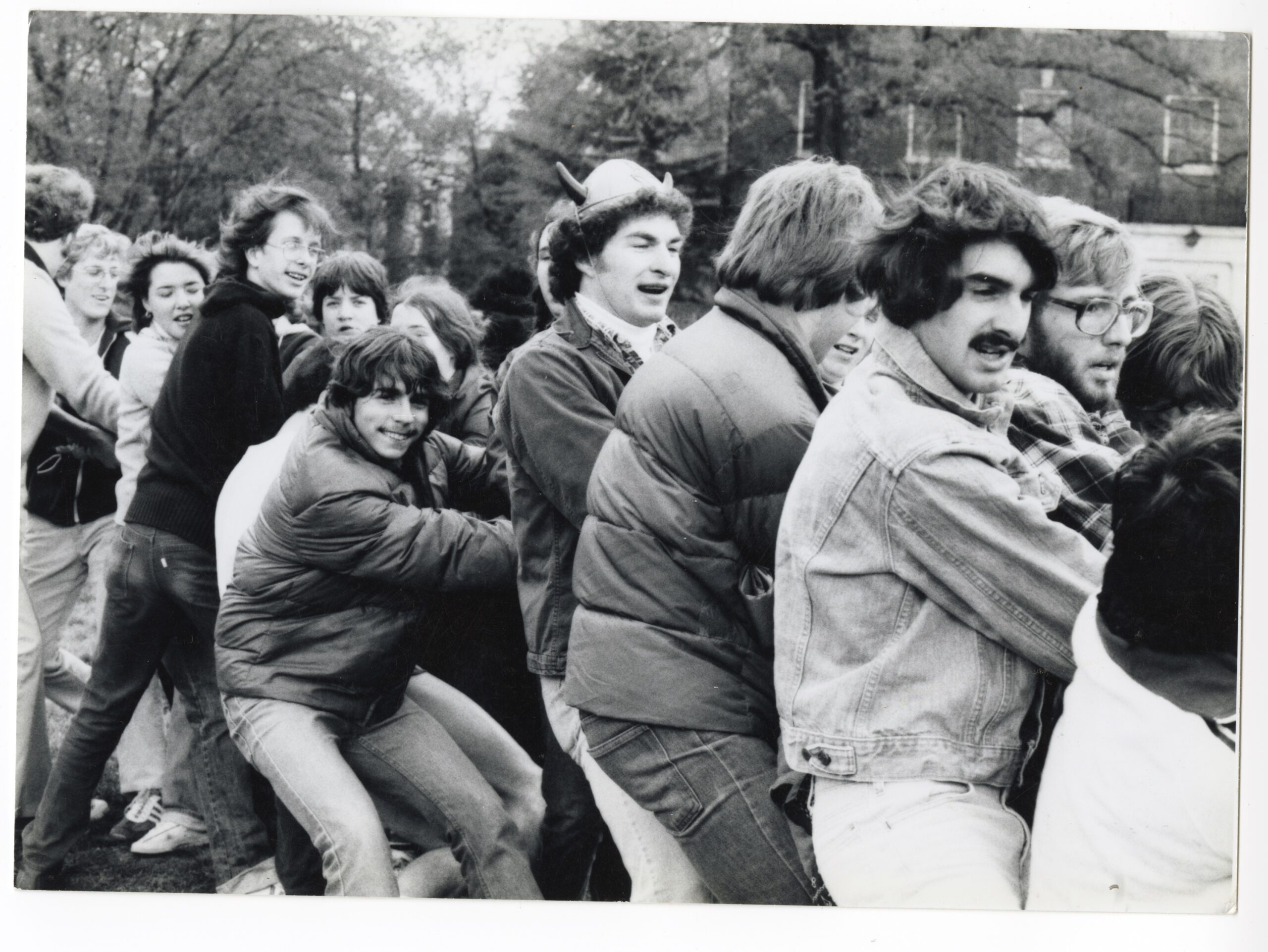
Devil-Goat Day is over! Unfortunately (or maybe fortunately?) the 100 Years of Devil-Goat Day project is officially over as well. My project group presented at the university’s History Symposium yesterday (Friday, 4/25), the final step (outside of this blog post) for the class. RIP History 428: Digital History (not dead, I’m just gonna miss it. It’s been fun.)
Our project’s primary goal was to document, preserve, and interpret 100 years of Devil-Goat Day by creating a dedicated archive for the event. This was all lain out in the project contract, created at the beginning of the semester to provide a baseline for the project, and a basic schedule for us to follow in the creation of our archive. The only part of the contract that we were unable to keep was the original idea of 10 items per decade. While this number was easily achievable for some decades, especially the 1980s and the 2020s. There were other decades, such as the 1920s, 1990s, and 2000s, for which we were unable to find enough items to meet the original minimum of 10. We discussed this with Dr. McClurken, and ultimately decided that it was more important to just get what we could up, and describe possible reasons for a lack of items in each decade post.
Due to my experience with WordPress, website building, and technology, my primary role in the group was to build, design, and maintain the website while we were working. This was a lot of fun for me, and a major test of my skills, as block after block broke, or did not function for what we needed. At one point, I had to hand code almost 97 citations with custom HTML and CSS so that it would display correctly. Possibly due to the limits of WordPress, this also did not function as we expected, and so we ultimately decided to do away with the formatting choices.
In the process of website building, we discussed, and made a very conscious decision to apply as close as possible to current accessibility standards. We added an accessibility statement, with a place for input if things needed to be fixed. We also added an accessibility plug-in (AccessYes) that allowed for a lot more accessibility options than any other I had used before this project. That same plug-in has since been installed on this site and on my art portfolio website.
Overall, this project taught me a lot about the processes behind digital history projects, the behind the scenes of the kinds of teams that build these sites, and created a site that hopefully introduces the wonder of Devil-Goat Day and it’s history to generations of UMW students to come. (Go Devils!)
Leave a Reply